skip to main |
skip to sidebar
 MIKE HAWTHORNWORLD CHAMPION - 1958
GRANDS PRIX - 47
WINS - 3
POLE POSITIONS - 4
POINTS SCORED - 127.64
--- F1 CAREER ---
1952 - Cooper - Equal 4th - 10pts
1953 - Ferrari - 4th - 19pts
1954 - Ferrari - 3rd - 24.64pts
1955 - Ferrari / Vanwall - 0pts
1956 - Maserati - 12th - 4pts
1957 - Lancia /Ferrari - 4th - 13pts
1958 - Ferrari - 1st - 42ptsOK the top 10 British drivers, now were getting towards some real legends of the sport starting at number 10 with tha man who became one of Britain's first motorsport household names and his name is written in history as the man of many firsts. The first British driver to win a world championship Grand Prix and also of course, the first British driver to win a Formula 1 World Championship, that man being the late Mike Hawthorn from Mexborough in South Yorkshire.
Unlike nearly all British drivers back in those dys, Hawthorn came from a less wealthy background. After leaving school, he got a job working at a power station in Doncaster before his obsession with cars and racing got the better of him and he started competing in local races, to further his progression, Mike's dad relocated the family to Farnham in Surrey, just a stones throw from the legendary Brooklands track where Hawthorn began his career full time, not on 4 wheels but 2. He started off racing motorbikes, on a 350cc BSA trial bike, he won "best novice" in his very first race in the category in 1947. Primarialy, Mike had wanted to follow his dad and become an engineer so he combined his racing on bikes with his engineering studies, but the problem here was that despite showing promise on the track, he struggled in the classroom, so he and his dad Leslie took the difficult and risky decision to go motor racing full time the following year.
Even very early on it seemed that the gamble they took had already paid off as Mike continued his rapid progression through the ranks right up to his first proper race car, Leslie had managed to buy an F2 Cooper T20 in which he would make his Formula 1 debut in Belgium in 1952, he finished a stunning 4th behind Alberto Ascari (1st), Giuseppe Farina (2nd) and Robert Manzon (3rd), the best non Ferrari in the 22 car field. He went one better at Silverstone finishing in 3rd before repeating his Belgium performance at Zandvoort, overall, this meant Hawthorn earned in his first season a top 5 championship finish and by far the best non Ferrari, also Hawthorn was now the new rising star. Promise enough for the young Mike to part company with the privateer team his dad began and signed a big money deal with Ferrari for 2 years, he didnt let down his new employers with a series of solid drives, the highlight being that historic 1st win at Reims after edging an epic battle with Juan Manuel Fangio's Maserati.
Meanwhile, Hawthorn doubled up his F1 exploits for a now annual crack at the Le Mans 24 Hours for Jaguar which culminated in victory while driving one of the legendary D-Type's in the tragic 1955 race where Mercedes driver Pierre Levegh crashed violently on the pit straight killing him and 82 spectators, an accident which prompted Mercedes to quit Formula 1 until their return in 1993. Hawthorn went on to win the race with his teammate Ivor Bueb, beating the Aston Martin of Peter Collins and the Belgian driver Paul Frere by 5 laps, but the tragedy surrounding Levegh marred what was supposed to be a glorious day for British Motorsport.
Hawthorn kept racing a bit part program in F1 while racing for Le Mans and he returned full time with Lancia in 1957, his season though was put into limbo when the Lancia team were declared Bankrupt and then swallowed up by Ferrari so a hastily arranged switch to Ferrari's 801 machine was made and Hawthorn recovered to take 4th in the standings, and with Fangio pretty much announcing his retirement after his legendary herculean drive at the German Grand Prix of 1957, the title race would become an all British affair in 1958, Hawthorn and Peter Collins in their Ferrari's against Stirling Moss and Tony Brooks in the Vanwalls (a 4 way fight that eventually became 3 after Peter Collins's tragic death in Germany) There would also be the odd forays by the Cooper pair of Roy Salvadori and the French veteran Maurice Trintignant.
It turned out to be a titanic struggle between the top 3 (Hawthorn, Moss, Brooks) to see who would become the first British world champion, Going into the final round in Morocco though, controversy was still in the air, Hawthorn (who had only won one race) went in 3 points clear of Moss instead of 1 after a disqualification for cheating in Portugal was overturned after an intervention by none other than his title rival Moss, a wonderous show of sportsmanship ensuring that all Hawthorn needed to do was to finish 2nd and the crown would be his, no matter what Moss did. Moss did all he could, dominating the event by winning and setting fastest lap (which back then you got a point for) but after a bit of team play on Ferrari's part, the American driver Phil Hill let his teammate Hawthorn through to 2nd place and claim the title by 1 point, after which Hawthorn thanked Moss for a great title fight and then announced his retirement from the sport, talk about going out on a high.
Or so it seemed, just 3 months later, while in wet conditions on the A3 near Guildford, Hawthorn in a Jaguar Mark 1 Sedan, crashed to his death, an accident that shocked the whole nation. The cause of the accident remains a mystery, but later on it was revealed that Hawthorn apparently was slowly dying anyway due to an incurable kidney condition, either way, it was a huge loss to British motorsport.
His legacy though lives on, a memorial headstone was built near the family home in Farnham which is regularly visited by racing fans from right around the world and also a life sized statue of him at Lord March's Goodwood track in West Sussex, also every year since 1959 there has been the awarding of the Mike Hawthorn Memorial Trophy by the BRDC, this is awarded to the most successful (i.e. highest points scoring) Commonwealth driver in Formula 1 each year. Nigel Mansell being the record holder winning the award on 7 occasions.
 LEWIS HAMILTONWORLD CHAMPION - 2008
GRANDS PRIX - 35
WINS - 9
POLE POSITIONS - 13
POINTS SCORED - 207
--- F1 CAREER ---
2007 - McLaren Mercedes - Equal 2nd - 109pts
2008 - McLaren Mercedes - 1st - 98pts
You may be wondering why i have put the new golden boy of British motorsport so far down the list of my top 20 British F1 drivers, well the reason is simple, he's only been racing for 2 seasons and he has'nt done enough yet to break into my top 10, but there is scope for the future, he is young he is extremely talented and can achieve a lot more in the future, enough hopefully to earn a higher placing in my opinion.
Anyway, about Lewis, this young man from Stevenage in Hertfordshire is unique in a way as he is one of the few drivers that did not come from a wealthy background which is often needed to break into the sport, infact he was brought up by his parents on a council estate and also had to suffer his parents splitting up when just a 2 year old, once moving back with his dad Anthony, his stepmother Linda, and his disabled brother Nicholas who suffers from cerebal palsy and who Lewis himself calls his inspiration because his brother (like his early racing career) triumphed over adversity against all the odds.
A young Lewis Hamilton first caught the national attention at the age of 10 when he attended the Autosport awards in 1995 to recieve his British Junior Karting championship trophy and it was here when he had his first (and now famous) meeting with McLaren team boss Ron Dennis when he uncannily walked up to meet him and proclaimed he would drive one of his cars soon, Dennis funnily enough gave him his number and told Lewis to call him back in 9 years to sort something out.
His call would come much much earler, infact just 3 years later when Lewis won the British Junior Championship for the 2nd time, Dennis signed him up on the spot on McLaren's junior driver scholarship. With McLaren backing, Hamilton progressed through the karting ranks at an incredible rate progressing to European Formula A level (the top level at Karts in Europe which is now known as KF1) at the age of just 15. This would be the first time he would meet future F1 rival and good friend Nico Rosberg, son of the 1982 champion Keke, racing as teammates, they blew away the opposition, well all except the dutchman Carlo Van Dam who beat both of them, despite that Hamilton was awarded a BRDC Rising Star medal for 2000.
Hamilton had already done enough to secure his first single seater drive in Formula Renault UK for the 2002 season with Manor, while Rosberg wento ff to race Formula BMW in Germany. Lewis had an unspectacular first season as he struggled to get to grips with the new more powerful machinery, he would eventually win 3 races in the 2nd half of the season and go on to finish 3rd in the standings behing eventual champon Danny Watts. With a years experience, he blew away the opposition the next year winning half the races to take a commanding first championship honour ahead of Alex Lloyd, Lloyd would get the consolation of beating him to the prestigious McLaren Autosport prize.
After a bad debut in British F3 and improved showings in the Macau Grand Prix of 2003, Manor decided to graduate to the newly formed F3 Euroseries for 2004 with Hamilton joining them along with dutchman Charles Zwolsman, it was both a gamble and a hinderence as the Manor team would enter with a 2 year old Dallara Mercedes package. But Hamilton had a great 1st season despite the chassis disadvantage, after a slow start, Hamilton shocked the opposition with a battling win on the streets of Nuremberg, his first international racing victory and he never finished outside the top 7 in each of the final 8 races giving him 5th in the championship behind his friend Rosberg and way behind the eventual champion and fellow countryman Jamie Green.
Despite the promise of an up to date car for next season, Hamilton decided to take up an offer to drive for the series leading squad ASM for 2005 where he would meet for the first time another good friend and rival Adrian Sutil as teammate. Just like in Formula Renault UK, he used last years experience to great effect with the difference being this time he was driving for the best team on the grid, as a reuslt, Hamilton astonishingly went on to rip apart the record books by winning 15 of the 20 races, scoring 172 points which helped him finish 78 clear of Sutil and a huge 109 clear of future F1 star Sebastian Vettel.
The next step up was GP2, the official Formula 1 feeder series. Hamilton's friend Nico Rosberg won the title the previous year thus earning an F1 drive with the Williams team, Hamilton would replace him at ART, the team run by Nicolas Todt, the son of Ferrari boss (at the time) Jean Todt. Crucially for Hamilton, he would have an experienced teammate in the form of Alex Premat and this would be important as Hamilton eventually broke his trend of winning titles at the 2nd attempt by winning at the 1st attempt here, but unlike in Formula Renault and Formula 3, his title win was no walk in the park as he endured a season long battle with the Brazilian youngster Nelson piquet jr, winning eventually with 1 race to spare by 12 points.
But speculation over a possible early graduation to F1 with McLaren started way back in mid-season when McLaren's number 2 driver Juan Pablo Montoya made the shock decision to quit and move to NASCAR, this left a vacant seat alongside the new world champion Fernando Alonso for 2007, Hamilton (due to his connections with Ron Dennis) was offered a test and the chance of a drive against Gary Paffett and Pedro De La Rosa (the latter stood in for Montoya for the 2nd half of the season scoring 20 points.) Hamilton eventually won the drive.
Any hopes Hamilton had for a quiet debut season were gazumped by the attitude of the British media becuase of his presence in one of the sports leading teams, it was very difficult for him to focus himself on the task at hand which would be at first to aid Fernando Alonso to a possible 3rd successive world title against Ferrari's all new lineup of Felipe Massa and Kimi Raikkonen. He had a spectacular debut finishing on the podium in Australia before producing an excellent rear-gunner drive to hold off the Ferraris allowing Alonso to win, this would be when relations between the 2 would be at their peak. He lost out to Felipe Massa in Bahrain despite a late race charge but a 2nd place in Spain meant he created history by becoming the youngest driver ever to lead the championship.
The good times would not last though and the seeds of dissention between the 2 drivers first came to ahead in the next race at Monaco, McLaren doninated taking a 1-2 finish but Hamilton was incensed at not being allowed to race teammate Alonso for the win, the team survived a "team-orders" hearing afterwards and the result stood. Hamilton made up for his disappointment with a dominant performance in a chaotic weekend in Canada, Hamilton coasted to an easy win as chaos erupted everywhere else, Alonso ran the final 3rd of the race on the wrong tyres and finished way down in 7th, Alonso, clearly rattled by Hamilton's performance began to suspect whether the team were favouring Hamilton and this was apparent when a faster Hamilton tried to pass Alonso at the next race in Indianapolis, he defended his position as if he was racing for a rival team, Hamilton went on to take another win with Alonso again way back.
More podiums followed in France and Britain but his luck would soo change after that, a nasty crash in qualifying at the Nurburgring meant he could only finish 9th while Alonso won. And it was qualifying again which nailed everybody's suspicions about team morale, Alonso blocked Hamilton in the pitlane to prevent Hamilton from setting a quick lap, Alonso as a result was penalised 5 places on the grid and the McLaren team were deucted 15 points in the constructors championship, Hamilton went on to win. Then Hamilton suffered a puncture in Turkey while on course for another podium and Alonso beat him in a 1-2 in Italy. It was after that when the Spygate affair came to light which ripped the sport apart, McLaren were excluded form the constructors championship and were hit with a record fine after allegations of spying between McLaren designers and british Ferrari employees. Some felt that with the drivers being repireived of any blame that McLaren still got off lightly.
But repireved they were and in the next race in Japan, Hamilton gave a masteful wet weather performance in treacharous conditions, he won while Alonso crashed out, this meant he had a 12 point lead going into the final 2 races. But for the first time, his inexperience began to show, a miscommunication between him and the team in China meant Hamilton ran longer than he was supposed to on his st stint on intermediate tyres, and when coming into the pits, he had no grip and slid off into a gravel bank forcing retirement. And in the title decider in Brazil, he only needed to finish 5th to be champion but ran wide on the 1st lap then dropped back to last after a gearbox malfunction, he fought back to finish 7th but it was not enough, Kimi Raikkonen won the title by a single point.
Hamilton had high hopes for 2008, he had just signed a new 5 year contract making him one of Britian's highest paid sportsmen, the sulking Alonso went back to Renault and Hamilton would be joined by Heikki Kovalainen who himself had an impressive debut season the previous year. The year started off perfectly for Hamilton with victory in Australia, his good friend Nico Rosberg scoring his first podium and none of his predicted title challengers scored points. But the next 2 months would be a struggle as Ferrari began to show better pace by winning the next 4 races, Hamilton only managed 2 podiums in that time. But then came Monaco and Hamilton had one of his luckiest days, as the rain came down early on, Hamilton clipped the barriers and suffered a puncture, his team immediately changed tactics and put him on intermediate tyres, this would prove crucial as everyone else pitted under a safety car period and Hamilton on used tyres went on to assume and then build up a big lead, with which he went on to take an emotional win.
The good fortune would not last though as a pit lane calamity in Canada and a penalty in France put him off the pace going into his home round at Silverstone where he would produce arguably his greatest drive to date, aided by a bungling strategy from Ferrari, Hamilton gave a masterful drive in torrential conditions on intermediate tyres, he was consistently 6 seconds a lap quicker than everyone on the same tyres and he went on to win by over a minute lapping everyone but Nick Heidfeld and the popular Rubens Barrichello, it was a preformence that was compared with Ayrton Senna's win in similar conditions in Portugal in 1985. Another win follwed in Germany before a puncture in Hungary looked like he would see his world title hopes fritter away as he was lying down in 6th place, but he recieved a huge stroke of luck as title rival Felipe Massa amazingly blew his engine with 3 laps to go, even better for Hamilton, his teammate Heikki Kovalainen benefitted to take his maiden win.
2nd place in Valencia (behind Massa) followed before yet more controversy in Belgium, after Ferrari dominated, it began to rain again and leader Kimi Raikkonen began to struggle in the conditions, Hamilton reeled him in and made his move on the with 2 laps to go, he was put wide by Raikkonen forcing Hamilton to cut the chicane, Hamilton then let him back through (as he was obliged to do under the rules) but then immediately sat back into Raikkonen's slipstream and re-passed him at the very next corner, Raikkonen then later spun out giving Hamilton the win, which would then be taken off him for not giving up an advantage.
Italy came next and after Hamilton endured a terrible qualifying ending up 15th, he recovered to finish 7th but that was overshadowed by the maiden win of Sebastian Vettel. A solid drive then followed in Singapore finishing 3rd while Massa suffered more pit lane calamities. Japan was isntantly forgettable, desite starting on pole, Hamiltonw was penalised for a starting infringement and then controversially punted into a spin by Massa when Hamilton attempted to overtake him. He made up for it in China with a dominant win.
Thus bringing the championship again to the final round in Brazil and like the previous year, Hamilton again only needed a top 5 finish but this time he would prevail and claim the title in extremely dramatic circumstances, after changeable weather conditions, Hamilton's cautious approach meant he lay in 4th place but then the rain came, and after a change of tyres, Hamilton had dropped down to 5th after Timo Glock elected to stay out. Unusually for Hamilton he was struggling in the conditions to warm up his tyres and with 2 laps to go lost 5th place to Sebastian Vettel, Massa (who was leading) suddenly was in a championship winning position and he beleived he had done it when he crossed the line to win. But the McLaren strategists were calm and would be proved right in their judgement of the race, after Hamilton pitted, they were keeping an eye on Timo Glock's pace in case Vettel passed (which he did) and now Glock was struggling with Hamilton reeling him in at the rate of 10 seconds per sector, and as a result, he went on to overtake Glock for 5th place at the very last corner while the Brazilians were celebrating. Hamilton crossed the line and could'nt believe his luck, he had just become world champion minutes after he thought he had lost it.
Its under that success that hamilton will go into 2009 in good spirits, with Ron Dennis leaving his position at McLaren that is the only major change apart from the new techincal and aerodynamical regulations, as a reuslt of these changes, there will be more emphasis on driver skill so dont count agaisnt Hamilton joining an elite club of drivers who have won back to back titles.
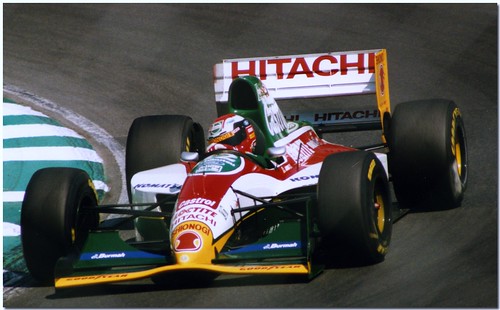 JOHNNY HERBERTGRANDS PRIX - 165
WINS - 3
BEST GRID POSITION - 4th three times
POINTS SCORED - 98
--- F1 CAREER ---
1989 - Benetton Ford / Tyrrell Ford - 14th - 5pts
1990 - Lotus Lamborghini - 0pts
1991 - Lotus Judd - 0pts
1992 - Lotus Ford - 15th - 2pts
1993 - Lotus Ford - 9th - 11pts
1994 - Lotus Mugen Honda / Benetton Ford - 0pts
1995 - Benetton Renault - 4th - 45pts
1996 - Sauber Petronas - 14th - 4pts
1997 - Sauber Petronas - 10th - 15pts
1998 - Sauber Petronas - 15th - 1pts
1999 - Stewart Ford - 8th - 15pts
2000 - Jaguar - 0pts
Right from the off, it was clear that Johnny Herbert from Romford in East London was a driver with some great potential, a potential that might have been fully realsied had it not have been for a horrific Formula 3000 crash at Brands Hatch in wich he broke both his legs, but he recovered sufficiently to become a solid performer in F1 scoring 3 race wins and also has a Le Mans 24 Hours win to his name.
Herbert first came to light by winning the prestigious British Formula Ford festival in 1985, a real event for up and coming young drivers, his performances in the category caught the attention of future F1 team boss Eddie Jordan who at the time was running teams in lower formulae. Jordan (on the basis of Herbert's FFord success) decided to give him a seat in one of his British Formula 3 cars, and the young Herbert would not let him down, 2 solid years eventually delivered the championship in 1987.
Logically Formula 3000 was the next step up and Herbert stayed with Jordan as they progressed to the category. Herbert had a fantastic debut by winning in Jerez before following it up with strong showings in Vallelunga, Silverstone, Monza and Pergusa. Going into round 6 he lay 3rd in the championship (despite missing round 3 at Pau) albeit a good 17 points behind the leader, Brazil's Roberto Moreno but he was in with a shout for 2nd only 2 points behind the Swiss driver Gregor Foitek. Herbert helped his cause by qualifying on pole for the race at Brands Hatch but started poorly as he was overtaken by teammate Martin Donnelly and Pierluigi Martini, But disaster was to follow just halfway through the lap.
As the field exited Surtees bend and onto the Pilgrims Drop, Donnely and Martini were away and clear but Herbert was tapped into a spin by Foitek which sent him into the armco at high speed and then Herbert was t-boned by the blameless Olivier Grouillard who had no time to react, catastrophe followed eliminating no less than 8 cars. Herbert broke both his legs and was very close to having one of his feet amputated as it was that badly damaged.
But Herbert proved everybody wrong and soon got himself back to full fitness and with the help of his long time friend and mentor Peter Collins, he confirmed his recovery by bagging a Grand prix drive with Benetton for 1989 (Collins was also the team's manager at the time) alongside Alessandro Nannini. He shocked everyone by bagging a brilliant points finish on his debut in Brazil with a 4th place, Herbert impressed right the way through including picking up a 5th place in Phoenix, but now the team were coming under new management, Collins was replaced by the flamboyant Italian Flavio Briatore and he insisted on an all Italian driver lineup so when Herbert failed to qualify for the Canadian Grand Prix, he was fired and replaced by Emanuelle Pirro. Upset with his dismissal, Herbert went off to race in Formula Nippon in Japan to pass the time and see out the 1989 season. But Tyrrell offered him a part time contract to drive in 2 races while Jean Alesi was pre-occupied, lack of knowledge of the car was apparent as he produced sub-standard results in those 2 outings including a DNQ in Portugal.
Peter Collins then re-signed Herbert to drive for Lotus in 1990 after their original choice of driver Martin Donnelly suffered a horrific qualifying accident for round 14 in Spain which finished his career, Herbert was given the drive for the final 2 races but retired from both, but he had shown enough in those 2 races to earn a contract for 1991 as a test driver. a test driver because he had signed a deal to go sportscar racing and compete in the Le Mans 24 Hours that year with Mazda and he won the worlds mot famous endurance race in one of their famous Orange and Green 787B's alongside Bertrand Gachot and Volker Weidler. But his F1 career would be reborn again earlier than expected that year after the sacking of Lotus's 2nd driver Julian Bailey. Herbert filled in when not on Sportscar duty and performed well, scoring a best finish of 7th in Belgium.
Those displays earned him a race seat for 1992 alongside an unknown young Finn called Mika Hakkinen, it was the finnish driver who was the team's bright spark as he helped Lotus finish in the top 5 of the constructors championship for the first time in 4 years, Herbert was somewhat overshadowed by Hakkinen but he did score 2 points finishes of his own in France and South Africa. Herbert stayed on for 1993 and as Hakkinen signed for McLaren, Herbert was now the team's number 1 driver alongside Alex Zanardi. Herbert grabbed his big chance with both hands, the new car was competitive right from the off and Herbert notched up four top 5 finishes to grab 11 points and 9th in the championship, his 4th place at Silverstone being the most satisfying for him.
There was a lot of promise for 1994, another new car and a factory engine deal with Mugen Honda, alongside Pedro Lamy, Herbert believed he could really push on and start fighting for podiums. But the Lotus 109 was a joke right out of the factory, it was overweight and substantially underdeveloped as the team were now struggling to pay off a mounting debt, Herbert did manage five top 10 finishes but no points, and he was forced to quit when the team were nearly bankrupt and began hiring pay drivers, they eventually closed their doors at the end of 1994.
Herbert though had done enough to earn a contract with Benetton for 1995 alongside Michael Schumacher, finally a chance with a real front running team and car, and with Renault engines, their B195 was the best car on the grid. Herbert used it well, scoring his first points finish in 22 races in Argentina, he then went on to secure his first podium finish in Spain before an emotional first win at Silverstone albeit in fortuitous circumstances, he assumed the lead after Schumacher and Damon Hill's famous collision with 16 laps to go and he was struggling to hold off David Coulthard's Williams before he was given a 10 second pit speeding penalty, Herbert went on to claim his first victory in his 74th race. In similar circumstances, he went on to win in Italy after Hill and Schumacher again collided. It was a fantastic year for Herbert scoring 45 points, good enough for 4th place and good enough to help Benetton win the constructors championship.
But not good enough as it seemed for Flavio Briatore who after seeing Schumacher snared away by a £25million a year deal from Ferrari, he sacked Herbert in favour of the ageing duo of Gerhard Berger and Jean Alesi. Herbert was now out in the cold but he did sign a late deal with Sauber for 1996. It would be a poor year though, only one points finish (a podium in Monaco) 4 points and 14th place in the championship was not what he needed after the highs of the previous year, Herbert was brought back down to earth with a bump. But he kept faith with Sauber for 1997 and his loyalty was to be rewarded, Sauber's designer Leo Ress had produced a tidy little machine and with a better Petronas engine (a re-badged 1996 Ferrari), Herbert was able to mix it at the front of the pack on a regular basis, he was a regular in the top 10 and scored a deserved podium in Hungary, he ended up with 15 points, which was good eouhg for 10th, on the whole though, his performances that year deserves a hell of a lot better, especially after he was cynically punted off the track in Italy by Ralf Schumacher while running well.
1998 though seemed like de-ja-vu again, after feeling like 2nd fiddle alongside Hakkinen in 1992 and Schumacher in 1995, Herbert again felt he was being cast aside this time by Jean Alesi who had joined Sauber in place of Norberto Fontana, scoring a single points finish in the opening round in Melbourne, Alesi meanwhile scored multiple points finishes including a podium in Belgium as the team largely focused on him, Herbert became disillusioned and announced he would leave Sauber at the end of the 1998 season after finishing with a miserable 1 point.
1999 would bring a fresh start afte rsigning for Jackie Stewart's team who had produced a neat little car with a much improved engine from Ford, partnering Rubens Barrichello, the team improved as the season progressed and Herbert was to reap big benefits taking advantage of a chaotic European Grand Prix that year to take a memorable win from 14th on the grid, memorable as it was Stewart's first (and only) win in F1, he may have acted as a number 2 driver to Barrichello but now Herbert was enjoying his racing again, finishing with 15 points which was good enough for a top 8 place.
2000 though would be different, Stewart had been bought out by Ford and renamed Jaguar, Barrichello had left to join Ferrari and had been replaced by Ferrari refugee Eddie Irvine, a sale which was hoped to bring a bright future to the team, but it was more of a white elephant than a golden asset, 2000 especially, the chassis was a disaster, the engine was poor and unreliable and both drivers complained of aerodynamic defects with the car, Herbert became disillusioned again and announced his retirement from the sport, he would go out in some fashion though suffering a scary crash after a rear suspension collapse in Malaysia.
Today Herbert is still racing, he had attpemted to add to his Le Mans win in 1991 with 4 other attempts with Bentley, Audi and Aston Martin, all of which came to nothing, today he races in the Arab-based Speedcar Stock series in which he is the reigning champion

